Wednesday, July 18, 2012

Join the cosmic carnival

It recently struck me that I'm on a huge merry-go-round: one of those kiddy carnival rides with the horses going in circles.

 In fact we all are.

 One that is infinitely complex but at the same time elegantly simple. The earth moves around the sun in 365 days....a 365-day merry-go-round.


It gets better because the earth spins on its own axis within 24hrs. So its more like one of those wild shell rides that make school carnivals so popular.

 Amidst this cosmic carnival there's walking, driving, and for those lucky enough, flying. The weird thing is that the more you move, the less you enjoy the ride and the more likely you are to lose your balance.

 Imagine standing up on the carnival merry-go-round.

 So, today I decided I'm gonna sit down for 15 minutes, write a blog, and enjoy the ride.

Wednesday, March 28, 2012

The universe, humility, and a better world

Heya,

We now know that the universe is approximately 13.7 billion year old. The planet which we inhabit has existed for close to 4.5 billion years. What do these colossal numbers mean? A popular online analogy considers the age of the universe as one year. On January 1, 12am the Big Bang occurs, in early February our Milky Way galaxy forms, August 12 the earth and sun forms, the human species appears on December 31, 11:59 pm and 30 seconds. Modern humans only make an appearance in the last 30 seconds of an entire year in the universe’s history.


Understanding these profound facts has far reaching implications for the human psyche. The findings of scientific endeavours mark a clarion call for humans to embrace one of the main tenets of universal religious teachings: the teaching of humility. Derived from the latin word humilitas, it can also be translated as “grounded”, “from the earth”, or “low”.

In his book, The universe around us, Sir James Jeans hails the discoveries of Galileo which refuted biblical claims that the earth was the centre of the universe. Of mankind at the time he says, “Inexorable facts now dethroned him from his self-arrogated station at the centre of the universe; henceforth he must reconcile himself to the humble position of the inhabitant of a speck of dust, and adjust his views on the meaning of human life accordingly”.

It is ironic that science nudges humanity towards a more humble understanding of the universe. In 1615 the church considered Galileo’s (also known as the ‘father of modern science’) views on heliocentrism as heretic and condemned him to house arrest. Today most religious groups continue to instigate a war between religion and science. In Critique of Intelligent Design, Foster et al quotes the Gallup poll where “45 percent of the U.S. population believes that human beings were created by God in their present form sometime in the last 10 000 years”. These creationist doctrines seek to refute scientific findings of a 13.7 billion year old universe.

In the U.S. the situation is particularly bad and Foster et al notes that “new creationism is not simply a movement on the margins of society. It has received strong support from influential conservative political actors and opinion makers such as Ronald Reagan, Edwin Meese, George Gilder, William F. Buckley, Tom DeLay, John McCain, and George W. Bush”. These leaders are known to have displayed arrogance within the context of critical issues like natural resources.


The consequences of this level of ignorance have far-reaching implications for society. Decision makers who espouse creationist doctrines are unable to engage critically with crucial politico-scientific issues like HIV/AIDS and the threats posed by global climate change.

The perspective provided by a scientific understanding of the age of the universe is integral to the cohesion of modern society. It is the first steps towards cultivating a scientific worldview. Within the South African context a scientific worldview will form the basis of the envisaged knowledge based economy outlined in the Department of Science and Technology’s ten year plan. The general population will need to be conversant in key scientific issues like agriculture, pharmaceutics, energy security, and global climate change science.

In order to develop a scientific worldview the population needs to learn about the age of the universe and the earth at school level. This will lay the groundwork for an effective curriculum which includes the teaching of evolution. Evolution forms the basis of most advances in frontier medical science like HIV/AIDS research. Despite its importance progressive teachers are being ostracised for teaching the subject. In what seems like a ‘modern-day Galileo’ story, News24 online recently reported about a Cape Town teacher who was forced to resign due to pressure from colleagues and parents to exclude evolution from the syllabus.

Indeed South Africa faces a threat from American creationist institutions. In An introduction to pentacostalism: Global Charismatic Christianity, Allan Anderson states that “Pentecostal churches constitute the fastest growing group of churches in Christianity today, representing a quarter of all Christians worldwide”. These groups vehemently punt creationist doctrines which retard the gains achieved from a scientific understanding of the world.

It is our duty to guard the scientific gains achieved during the last two centuries. Science has not only proved that it has the potential to increase the quality of human life but also seems to calibrate humanity’s moral compass.

Monday, March 26, 2012

Rugby: A playground for charismatics?

Heya,

Recently Prof Albert Grundlingh, from the History department of Stellenbosch University, unpacked his thoughts on the occurrences of rugby players showing public testimonies of faith. Most notable was the Bulls Super Rugby Final victory when backline player, Jaco van der Westhuizen, stripped off his rugby jersey to reveal T-shirt with the words: “Jesus is King!”


“Van der Westhuizen also later expressed belief in a charismatic faith healer in Nigeria,” said Grundlingh.

Several Springbok rugby heavy weights including former coach, Peter de Villiers, former captain Victor Matfield, and fullback Gio Aplon, have displayed a penchant for charismatic movements such as Angus Buchan’s “Mighty Men” and “His people” church.

Grundlingh highlighted the fact that a variety of factors have resulted in the close relationship between rugby and religion. Angus Buchan’s “Mighty Men” reinforces patriarchal notions, seeks to “develop Christian men”, and calls for men to “affirm their phallic, warrior, and fathering instincts.”


The Christian publication, “Agter die doellyn”, includes testimonies by prominent Springboks (Morné Steyn, Kobus Wiese, Beast Mtawarira, and Ruben Kruger). These suggest that a spiritual system of belief is necessary for players to perform at the highest physical and mental levels.


“Everyday I wake up thinking of the blessing the Lord gave me. It takes hard work and discipline, but the main factor for me is GOD,” says Aplon.
According to Grundlingh players were not always so open about their religious affiliations. In the past most players were Afrikaner and belonged to the Dutch Reformed Church. “Springbok rugby players might have prayed before a match but it all happened discreetly,” said Grundlingh.

The turning point occurred at the 1995 Rugby World Cup victory when the team huddled together on the field for a thanksgiving prayer. “Apart from the player’s obvious gratitude in winning the game it in retrospect signalled that a new space has opened up for players to publicly embrace religion if they chose to do so,” said Grundlingh.

Thursday, March 8, 2012

MOJO week

RACE TALK BREAKS DOWN


Stellenbosch. ”The colour of money: the race/class divide in SA” was arguably one of the most controversial topics explored during the Stellenbosch University MOJO (Maak Oop Jou Oë) week. Guest speaker Khanyisile Mbongwa opened the talk with an emotive and profane poem, which captured her frustration at the culture of “whiteness”.

On the backdrop of recent race and gender incidents at the Stellenbosch University, the MOJO week (20-25 February) initiative aims to create dialogue around controversial issues like sex and sexuality, gender, race, and the environment. On its Facebook page, the initiative recognises that it is “easy for students to fall into a state of apathy, creating a hush-hush culture and a lack of critical engagement on campus”.

Mbongwa, a performing artist, dance facilitator, and poet, took the attendees on an intimate journey of the frustration experienced by black women in South Africa. She situated her experiences within the intellectual context of Frantz Fanon, Robert Sobukwe, and Melissa Steyn. Mbongwa emphasized Fanon’s theory on “acculturation”, where the idea of “that which is black is subhuman” and “black females emulating white women” featured prominently. The atmosphere in the Metanoia dining hall venue was tense and almost tangible.

The talk was followed by a lengthy question and answer session which got heated when Journalism student, Kate Buclan, challenged the speaker’s assumptions in her comment that she was born after the fall of apartheid and did not have any hang-ups about race. An explosion of hands went up across the room and the situation immediately became hostile. The facilitator, Pieter Odendaal, failed to maintain the composure of the discussion which led to a breakdown in dialogue. As a result, much of the “white” participants retreated into the very “hush-hush” that MOJO week aims to avoid.

Sunday, February 26, 2012

An Inconvenient youth

Malema’s future according to Forde


Stellenbosch. The author of “An inconvenient youth: Julius Malema and the ‘new’ ANC”, Fiona Forde, presented the first STIAS (Stellenbosch Institute for Advanced Study) lecture of 2012 earlier this week. At a time when media are condemning the controversial ANC youth league leader to the history books, Forde advised the audience not to “write Malema’s political obituary in haste”.

Social scientist and long-time journalist, Fiona Forde, used the questions “Who are his followers?” and “What is his politics?” to place Julius Malema into context. Forde asked the audience what comes to mind with the term “masses” and what mental image it evokes. She was referring to the large majority of underprivileged South Africans who constitute “the masses”. More specifically Malema appeals to youth, unemployed, shack-dwellers, domestic workers, and the dispossessed. These are the people that have been ignored by the ruling ANC and are responding to Malema’s calls for nationalization of South Africa’s resources.

Forde drew the audience’s attention to the fact that South Africa has one of the largest economic divides between rich and poor. The situation ensures that Malema has a platform from which to “tap” into his constituency with “threatening and always menacing rhetoric”. It has become apparent that the ANC lacks the leadership to “reign in Malema”. “The ANC leadership doesn’t matter, the ‘rank and file’ decides”, says Forde.

According to Forde Malema’s political future depends on two major ANC events this year. The policy conference in June will reveal who ANC president Jacob Zuma’s challenger for the ANC top job is and the December ANC election conference in Mangaung. This will determine whether a more “Malema-friendly leadership will emerge”.


Forde was granted unlimited access to Malema for two years to write “An Inconvenient Youth”, her first book. She admits that “Malema is a complex and colourful character”. She also describes him as a hypocrite and political bully, but also acknowledges that “He is emotionally sensitive, open, witty, and entertaining” as a person. However, she concludes that “What I found in the person doesn’t redeem him as a politician”.

Saturday, February 18, 2012

"THE TOWN OF OAKS"

Heya,

So this was my first assignment for journalism 2012...hope you like it.


The “Town of Oaks”

In an age when concrete and asphalt dominates urban existence, the quaint town of Stellenbosch is an exception rather than the norm. A leisurely stroll along the streets of Stellenbosch is a surreal experience where time stops. Tall oak trees (Quercus robur) line the streets creating an atmosphere of agelessness and tranquillity.


What would the “Eikestad” or “Town of oaks” be without the majestic oak tree? For most Stellenbosch University students and town residents this is unthinkable. While sitting under one of the oaks in Crozier Street, Shawn Daniels, a BSc Human life science student, says “the oaks create a calm, relaxing atmosphere and provides fresh air”. “The oaks contribute to making Stellenbosch University one of the most beautiful campuses in South Africa”, she adds.

Oak trees have been an integral part of Stellenbosch for almost three centuries. Cultural historian, Dr. Matilda Burden, from the University of Stellenbosch explains that “Commander Van der Stel established “Van der Stel’s forest” on his first visit to the valley in 1679. It was founded on an island along the local Eerste River, sheltered by unspoilt indigenous trees” Soon thereafter the colonists cut down the local trees for timber and firewood. The High –Commissioner H.A. van Reede, who was probably the first botanist to visit “Stellenbosch” assessed the situation and recommended the planting of Dutch trees; including oaks.

Willem Adriaan Van der Stel, who succeeded his father as governor of the Cape, upheld his father’s policy of propagating the oak in Stellenbosch. “The oldest surviving trees were planted in 1812”, says Ms. Portia Bolton, urban green space manager at the Stellenbosch Municipality. These trees can still be found towering above the old streets including Van Ryneveld, Andringa, Bird, Plein, Van Riebeeck and Church. “This year our oldest oaks in Ryneveld Street will be 200 years old!!!” exclaims Bolton.

Several trees including one in Ryneveld Street were declared national monuments and enjoy protection under section 15 of the National Forests Act which states that “no person may cut, disturb, damage or destroy any protected tree”. According to Bolton a draft policy by the Stellenbosch Municipality will soon ensure the protection, conservation, and long term management of Stellenbosch’s entire oak tree heritage.

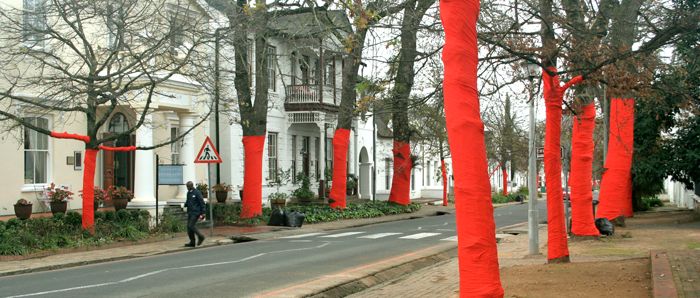
Despite their immense beauty, the Stellenbosch oaks have had a fair share of controversy. Dr Matilda burden recalls the “Battle of Andringa Street” in July 1940, where the coloured community defended themselves with oak branches from an attack by white students. A 2004 high court ruling against the Stellenbosch Municipality ensured that a woman was compensated for damages done to her BMW when a heavy branch fell and caused damage to the value of R40 000. In 2008, landscape artist Strijdom van der Merwe’s Dorp street exhibition caused mixed reactions from the Stellenbosch public. Trees lining the street were covered in 8000m of red cloth. According to Mimi Seyfert from the Stellenbosch library newspapers were swamped with letters from the public. “Some people complained that the tree squirrels may suffer as a result of the artwork”, says Seyfert.


In recent times the iconic oaks have come under threat from a white tree fungus which eats into the tree-trunk. This can be seen at one of the Church street oaks where the menacing fungus caused an entire section of the tree trunk to collapse onto the sidewalk. Johan Schuman from the irrigation department at Stellenbosch University says “we are feeding the trees organic fertilizer on a regular basis to slow the disease”.

In spite of the uncertainty facing the “Town of oaks”, the trees will always form an important part of the Stellenbosch history and will ensure that the town remains a tourism hub of the Western Cape in the near future.

Friday, January 6, 2012

Aldous Huxley

Heya,

So my uncle asks me;"what are you reading?" to which I reply "an autobiography on Aldous Huxley". With a dissapointing tone he reckons;"he can't be well known because I've never heard of him". I kept quiet, and thought to myself....

If only you knew. Aldous Huxley was the grandson of the prominent biologist Thomas Huxley, who is best known as "Darwin's bulldog" for his advocacy of the theory of evolution. Huxley jnr began his writing career in his middle twenties and soon established himself as a witty satirist.

His early days were punctuated with fascinating friendship circles and influences. These encounters formed the basis of many of his later novels much to the chagrin of the real-world characters. Huxley was an avid traveller and changed homes as often as underwear. It becomes apparent that his mobile lifestyle provided much inspiration for his writing.

So what exactly did Huxley write about? Well, I half-read his last novel titled "island" and started listening to an audiobook of "chrome yellow". His books seem to comprise much dialogue and he successfully uses the characters to breath life into his ideas. His interests are vast and include all the heavy hitters; religion, politics, gender, mysticism, science, drugs, sex. An absolute feast for my brain. Yes, I devour his ideas like a good braaivleis.

Oh yes, I also half-read "the Doors of perception" (an immensely popular 1960's rock band would later call themselves "the Doors"). Would you believe that this old geezer at the age of 61 experimented with mescalin? Mescalin is the active ingredient of peyote, a cactus plant native to Texas and Mexico. Through its psychoactive properties Huxley hoped to achieve enlightenment through artificial means....Nice try, dude! It sounds like a nice trip...Anyway, I expected more from the book.


Huxley is one of the few authors I know who uses his novels to explore the possibilities of integrating science and mysticism. I am a firm believer that similar endeavors holds much promise in the future. I certainly hope to add to this fascinating topic. I admire his willingness to test science and mysticism on himself. The most telling example was on his deathbed when he asked his wife to inject him with 100 micrograms of LSD...