So this was my first assignment for journalism 2012...hope you like it.
The “Town of Oaks”
In an age when concrete and asphalt dominates urban existence, the quaint town of Stellenbosch is an exception rather than the norm. A leisurely stroll along the streets of Stellenbosch is a surreal experience where time stops. Tall oak trees (Quercus robur) line the streets creating an atmosphere of agelessness and tranquillity.

What would the “Eikestad” or “Town of oaks” be without the majestic oak tree? For most Stellenbosch University students and town residents this is unthinkable. While sitting under one of the oaks in Crozier Street, Shawn Daniels, a BSc Human life science student, says “the oaks create a calm, relaxing atmosphere and provides fresh air”. “The oaks contribute to making Stellenbosch University one of the most beautiful campuses in South Africa”, she adds.
Oak trees have been an integral part of Stellenbosch for almost three centuries. Cultural historian, Dr. Matilda Burden, from the University of Stellenbosch explains that “Commander Van der Stel established “Van der Stel’s forest” on his first visit to the valley in 1679. It was founded on an island along the local Eerste River, sheltered by unspoilt indigenous trees” Soon thereafter the colonists cut down the local trees for timber and firewood. The High –Commissioner H.A. van Reede, who was probably the first botanist to visit “Stellenbosch” assessed the situation and recommended the planting of Dutch trees; including oaks.
Willem Adriaan Van der Stel, who succeeded his father as governor of the Cape, upheld his father’s policy of propagating the oak in Stellenbosch. “The oldest surviving trees were planted in 1812”, says Ms. Portia Bolton, urban green space manager at the Stellenbosch Municipality. These trees can still be found towering above the old streets including Van Ryneveld, Andringa, Bird, Plein, Van Riebeeck and Church. “This year our oldest oaks in Ryneveld Street will be 200 years old!!!” exclaims Bolton.
Several trees including one in Ryneveld Street were declared national monuments and enjoy protection under section 15 of the National Forests Act which states that “no person may cut, disturb, damage or destroy any protected tree”. According to Bolton a draft policy by the Stellenbosch Municipality will soon ensure the protection, conservation, and long term management of Stellenbosch’s entire oak tree heritage.
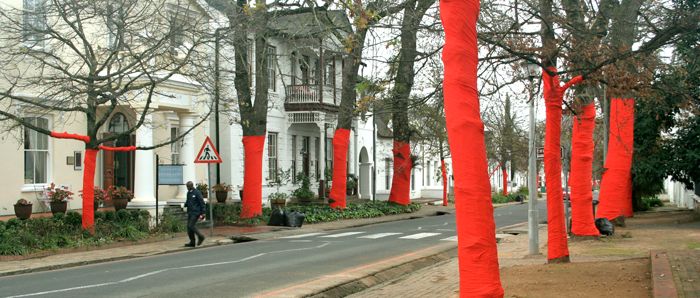
Despite their immense beauty, the Stellenbosch oaks have had a fair share of controversy. Dr Matilda burden recalls the “Battle of Andringa Street” in July 1940, where the coloured community defended themselves with oak branches from an attack by white students. A 2004 high court ruling against the Stellenbosch Municipality ensured that a woman was compensated for damages done to her BMW when a heavy branch fell and caused damage to the value of R40 000. In 2008, landscape artist Strijdom van der Merwe’s Dorp street exhibition caused mixed reactions from the Stellenbosch public. Trees lining the street were covered in 8000m of red cloth. According to Mimi Seyfert from the Stellenbosch library newspapers were swamped with letters from the public. “Some people complained that the tree squirrels may suffer as a result of the artwork”, says Seyfert.
In recent times the iconic oaks have come under threat from a white tree fungus which eats into the tree-trunk. This can be seen at one of the Church street oaks where the menacing fungus caused an entire section of the tree trunk to collapse onto the sidewalk. Johan Schuman from the irrigation department at Stellenbosch University says “we are feeding the trees organic fertilizer on a regular basis to slow the disease”.
In spite of the uncertainty facing the “Town of oaks”, the trees will always form an important part of the Stellenbosch history and will ensure that the town remains a tourism hub of the Western Cape in the near future.

No comments:
Post a Comment