Thursday, August 9, 2012

No pun intended: Chilling at the Kouebokkeveld


Due to its icy coldness the Kouebokkeveld produces some of the finest fruits; Dane McDonald visited Kunje Guest Farm to discover what the region had in store for winter tourists.

On an overcast day with dark clouds racing above the Boland mountain range like a pack of wolves, Bain’s Kloof pass looks eerie. The pass separates two worlds, geographically speaking. One passes from the wine-making wellington with a bearable clime to the sub-zero temperatures of the Kouebokkeveld: perfect for growing apples and pears.

Kunje Guest farm is situated 750 meters above sea level. Approaching from Ceres, the Gydo Pass with its forgiving inclines causes the local mercury to drop to unforgiving temperatures. Kunje owner and farmer, Theunis Hanekom, recalls how cold it was recently.

“It was as low as 6 degrees Celsius at five in the afternoon, and last Sunday it was 4 degrees in the morning. It gets very cold here,” he said.

It’s after four in the afternoon and the valley-farm is covered in shadows from the surrounding Kouebokkeveld Mountains. The reception is closed but outside the gate is a board with our names written on a package containing the keys to our cottage. Also included are a simple map and a dainty packet of dried fruit. A sense of safety and welcome is tangible.

Outside the car one feels a mellow coldness which eases itself into your bones. Rather than being discomforting it is reinvigorating: fresh cold air with a hint of fruity perfume. The cottage is situated on the other side of the R303, the road from Ceres which brings you to Kunje through countless orchards.

It’s a 10 minute drive on a well maintained gravel road which poses no problem for a small 1.4 Renault Sandero. The dried fruit is delicious and provides delightful “reception to accommodation padkos”.

The cottages are nestled among the tan-coloured boulders which make up the Cedarberg sandstone formations bordering the valley. The rock formations have patterns of erosion and crack that never cease to intrigue.

Cottages
Inside, the cottage is neatly, simply, and fully furnished. It is hard not to notice the large fireplace flanked by two windows and looking like a dead fire breathing monster. There are blankets folded in the lounge area and extra blankets in the rooms. A panel heater also rears its head in the corner of the room. We interpret these as warnings signs.

On the kitchen table is a basket with homemade treats including apricot jam, farm style rusks, and a bigger packet of the “dried padkos”. The dried fruit are made from the export quality fruits grown on the farm.

A third of Kunje’s fruit is exported to countries like America, Britain, the eastern regions, Russia, and much of Europe. According to Hanekom the fruit production aspect of his business is what he loves most about Kunje.

“To plant an orchard and see it grow or when people compliment your fruit on how they look or taste is very pleasing,” he said.

Next to the basket is a battered receipt book where patrons have scribbled their purchases. Visitors enjoy the idea of purchasing small treats produced in the local area. Hanekom says they run it like an honesty shop where visitors can just take what they like and leave the money.

Wood is a regular purchase with some buying up to four industrial size nylon farm bags. Hanekom provides wood from the orchards which is dry to the core. On the porch we find our stash; all sealed and ready to burn. 

It’s nearing 18h00 and the cold can be felt on the edges of your nostrils. The fireplace has been pre-packed with wood and is pregnant with a chunk of blitz. I strike a match to bring the monster to life. It takes about an hour for the heat to permeate the entire cottage, but it’s worth the wait.

Fifty shades of fire!
The fireplace is strategically built closer to the ground to allow the heat to rise slowly in the room. Best of all, there is a sitter which can be turned to face it. It’s perfect for a chill-out session with a glass of ruby red merlot and a book. The fireplace is also fitted with a braai place which means you do not have to freeze in order to get a sizzling lamb chop.

Be sure to take along a warm jacket to enjoy the captivating Kouebokkeveld nightsky. The powdery band of our milky way is clearly visible and looks like glittering magic dust. Keen stargazers should pack in their telescopic equipment.

Bed time is well catered for with crisp, tight fitting linens to keep the cold out.

It is worthwhile to enjoy mornings in bed while waiting for the day to defrost. A cup of coffee with Kunje’s farm style rusks is a must-have. Your steamy exhalation is pure enjoyment and meditation in itself.

The silence in the valley creates a pleasant vibration in the ear. I imagine that it’s the closest one will ever come to living in a vacuum. Nothingness. Not even thoughts. Despite the silence, time seems to pass quickly.
 
Late afternoons are a good time for long walks or a mountain bike ride to fill the lungs with cold, fresh air. The setting sun illuminates the bordering mountain in the east with a glowing orange due to the enhanced colour of the tan-brown rock faces.

Look out for dancing Cape sugarbird (Promerops cafer) with its flamboyant tail arrangement. The bird feeds almost exclusively on the Greyleaf Sugarbush (Protea laurifolia) which dots the landscape. The Cape sugarbird has a long, curved beak which is a great work of evolutionary design and is specialised for extracting nectar from the flowers.
Protea laurifolia (Greyleaf Sugarbush)

The protea flower is mesmerizing with its large, hairy petals forming a circular ring around densely-packed florets. The local fynbos is remarkable with white bristle bush (Metalasia Mericata) and other ericaceous plants covering the light orange soil like a green blanket.

Two of the walks lead to San bushman paintings. The first sequence can be found around a large boulder which looks like a small temple. The first painting from the path is of a large antelope and draws you off the path like a magnet. The painting seems to have lost some of its colouring over time.

Hanekom explains that the paintings have suffered much damage over the years. “Past visitors have damaged some of the paintings, but these have been restored by renowned archaeologist, Prof Janet Deacon, from the University of Cape Town.

San paintings
A walk around the boulder proves to be engaging. The paintings almost induce a trance and appear to speak with the subconscious. The rays from the setting sun enhanced the red ochre used for painting by the Bushmen.

The mercury drops rapidly from 4pm, soon after the sun disappears behind the mountains in the west. The cottage fireplace beckons. After one night it has established itself as part of a warming ritual: Orchard wood, blitz, matchstick, fire facing sitter and a book... Two more days of cold bliss.


Thursday, August 2, 2012

Who's Afrikaans is it anyway?


In the midst of a decline in the language, the Afrikaans speaking community is divided along racial lines. Social Anthropologist, Prof Kees van der Waal, told the Stellenbosch University community that there is a rift between white language activists promoting standard Afrikaans and black activists fighting for the inclusion of the non-standard or “Afrikaaps” variant.
According to van der Waal the rift developed due to ‘race’ and political status. “The Afrikaans of black speakers was regarded as socially inferior since the appropriation of Afrikaans for Afrikaner ethno-nationalism from the creolising lower class consisting of former slaves, Khoi, and poor whites,” he said.
Van der Waal says that the Afrikaans language is closely linked to white Afrikaner nationalism and sense of identity. Afrikaans is increasingly being threatened by the shift towards English in South Africa. In a letter to Rapport in 2010, columnist Jaco Kirsten said: “I detest ‘Engafrikaans’ and pure Afrikaans is increasingly a matter of importance to me”.
This sentiment is not shared by black Afrikaans-speakers. The 2009 Roots conference at the University of the Western Cape marked a “celebration of Afrikaans and its linguistic network in all its creole forms”. Prominent South African authors and language scholars, including Jakes Gerwel and Antjie Krog, were among the participants.

The hugely successful theatre production and documentary, Afrikaaps, “is an indication of the celebratory and politically conscious way that Afrikaans is reappropriated among previously marginalised Afrikaans-speakers”. These productions focus on the creole background of Afrikaans and place a large emphasis on the fact that the language originated in the Arabic community in the late 1700’s.
“Many black Afrikaans-speakers, especially in the Cape region, use both English and Afrikaans in their daily speech that reflects a non-ethnic and non-purist use of the language,” said van der Waal. In her poem ‘Kuns en Culture’, Ronelda Kamfer laments the exclusion of non-standard Afrikaans from Afrikaans culture.  
“Realities of language shift and creole forms of Afrikaans are not to be experienced as catastrophes to be averted by exclusivism and the patrolling of the borders of the pure, but as natural processes, even a cause for celebration,” said van der Waal. 

Wednesday, July 25, 2012

Stellenbosch company to use “Dark magic” to protect SKA from lightning


Dr Howard Charles Reader is an engineer, but some think he is a master of the dark arts. “Most people call it black magic, because they can’t see it and think, ‘Gee that’s complicated!’” he says.

MESA solutions, through which Reader consults, could play an integral role in protecting the Square Kilometre Array (SKA) telescope from lightning strikes. His work is not necessarily visible and is much like a magician making spells to protect the telescope from bolts of vicious lightning.

The SKA is set to be the world’s most powerful radio telescope. The project will enable radio astronomers to “see deeper into the mysteries of the universe’. “It will be a powerful time machine that scientists will use to go back in time to explore the origins of the first galaxies, stars, and planets,” according to the SKA website.

Lightning will pose a great risk to the SKA project. Indirect strikes enable clouds to descend with 100 000 amps worth of current, equivalent to 500 000 light bulbs. “It’s like a huge arch welder coming from the clouds,” says Reader. According to statistics the chosen area for SKA experiences only one lightning strike per square kilometre per year. Still, this is one too many, because it puts the equipment and research at risk.

Radio astronomers will be observing incredibly faint signals of events that have occurred as far back as 11.5 billion years ago. According to Reader the telescopic receivers on the SKA are highly sensitive. “If you put a cell phone on the moon, which is about 380 000 kilometres away and one of our dishes were to look at it, it would saturate its amplifier. It’s like me shouting so loudly that I break your eardrums.”

To avoid damage, MESA’s main strategy involves the careful management of cable layout. “This is probably one of the first telescopes in the world that has paid such attention to little details like how you lay out the whole structure,” says Reader. He explains; it is much better to place cables close together instead of far apart. A larger distance between cables increases the potential to capture interference such as lightning and cell phone signals. This strategy will be applied to telescope cables, power cables, data cables, and computer cables.

MESA will have the opportunity to work with international engineers and scientists. The company will promote interference mitigation policies carried out in a way that “incorporates quietness, lightning protection, and data smoothness”.


Thursday, July 19, 2012

50 shades of prostate

After a second visit to the doctor in under a week and a very likely third consultation I'm becoming very suspect.

Outside his surgery is parked a gleaming black Golf GTI. Now I understand that being a doctor is a very honorable vocation, but I sniffed some ostentation.

The reason for my visit was merely bureaucratic: you need a GP's referral to see a specialist. Fair enough. Some light banter here and there about my disorder which I dare say I know better than Dr handwriting.

If I'm paying R200-R400 for 10min at least write neatly.

Then, like a salesman swooping in on a deal, he starts pandering to my health concerns. I succumb. I definitely need a comprehensive health assessment....Sugar, cholesterol, kidney function, prostate.

Did he say PROSTATE!!


People, I spent the last three days agitating. I'm thinking legs apart, latex gloves, fingers...shit (no pun intended).

On my return visit I arrive 45min early. No. Actually the GP, more like leisurely 'Golf Player', strolls in 45min late. I enter the surgery. He draws blood...fortunately there's no need for S&M; technology I suppose.

The last 5min of my 10min visitation is used for the mandatory light banter here and there. All I'm thinking is why we needed an extra visit for this.

 It gets better because now I await a phone call which would likely tell me to come visit so that yours truly can tell me how sick I am.

Wednesday, July 18, 2012

Join the cosmic carnival

It recently struck me that I'm on a huge merry-go-round: one of those kiddy carnival rides with the horses going in circles.

 In fact we all are.

 One that is infinitely complex but at the same time elegantly simple. The earth moves around the sun in 365 days....a 365-day merry-go-round.


It gets better because the earth spins on its own axis within 24hrs. So its more like one of those wild shell rides that make school carnivals so popular.

 Amidst this cosmic carnival there's walking, driving, and for those lucky enough, flying. The weird thing is that the more you move, the less you enjoy the ride and the more likely you are to lose your balance.

 Imagine standing up on the carnival merry-go-round.

 So, today I decided I'm gonna sit down for 15 minutes, write a blog, and enjoy the ride.

Wednesday, March 28, 2012

The universe, humility, and a better world

Heya,

We now know that the universe is approximately 13.7 billion year old. The planet which we inhabit has existed for close to 4.5 billion years. What do these colossal numbers mean? A popular online analogy considers the age of the universe as one year. On January 1, 12am the Big Bang occurs, in early February our Milky Way galaxy forms, August 12 the earth and sun forms, the human species appears on December 31, 11:59 pm and 30 seconds. Modern humans only make an appearance in the last 30 seconds of an entire year in the universe’s history.


Understanding these profound facts has far reaching implications for the human psyche. The findings of scientific endeavours mark a clarion call for humans to embrace one of the main tenets of universal religious teachings: the teaching of humility. Derived from the latin word humilitas, it can also be translated as “grounded”, “from the earth”, or “low”.

In his book, The universe around us, Sir James Jeans hails the discoveries of Galileo which refuted biblical claims that the earth was the centre of the universe. Of mankind at the time he says, “Inexorable facts now dethroned him from his self-arrogated station at the centre of the universe; henceforth he must reconcile himself to the humble position of the inhabitant of a speck of dust, and adjust his views on the meaning of human life accordingly”.

It is ironic that science nudges humanity towards a more humble understanding of the universe. In 1615 the church considered Galileo’s (also known as the ‘father of modern science’) views on heliocentrism as heretic and condemned him to house arrest. Today most religious groups continue to instigate a war between religion and science. In Critique of Intelligent Design, Foster et al quotes the Gallup poll where “45 percent of the U.S. population believes that human beings were created by God in their present form sometime in the last 10 000 years”. These creationist doctrines seek to refute scientific findings of a 13.7 billion year old universe.

In the U.S. the situation is particularly bad and Foster et al notes that “new creationism is not simply a movement on the margins of society. It has received strong support from influential conservative political actors and opinion makers such as Ronald Reagan, Edwin Meese, George Gilder, William F. Buckley, Tom DeLay, John McCain, and George W. Bush”. These leaders are known to have displayed arrogance within the context of critical issues like natural resources.


The consequences of this level of ignorance have far-reaching implications for society. Decision makers who espouse creationist doctrines are unable to engage critically with crucial politico-scientific issues like HIV/AIDS and the threats posed by global climate change.

The perspective provided by a scientific understanding of the age of the universe is integral to the cohesion of modern society. It is the first steps towards cultivating a scientific worldview. Within the South African context a scientific worldview will form the basis of the envisaged knowledge based economy outlined in the Department of Science and Technology’s ten year plan. The general population will need to be conversant in key scientific issues like agriculture, pharmaceutics, energy security, and global climate change science.

In order to develop a scientific worldview the population needs to learn about the age of the universe and the earth at school level. This will lay the groundwork for an effective curriculum which includes the teaching of evolution. Evolution forms the basis of most advances in frontier medical science like HIV/AIDS research. Despite its importance progressive teachers are being ostracised for teaching the subject. In what seems like a ‘modern-day Galileo’ story, News24 online recently reported about a Cape Town teacher who was forced to resign due to pressure from colleagues and parents to exclude evolution from the syllabus.

Indeed South Africa faces a threat from American creationist institutions. In An introduction to pentacostalism: Global Charismatic Christianity, Allan Anderson states that “Pentecostal churches constitute the fastest growing group of churches in Christianity today, representing a quarter of all Christians worldwide”. These groups vehemently punt creationist doctrines which retard the gains achieved from a scientific understanding of the world.

It is our duty to guard the scientific gains achieved during the last two centuries. Science has not only proved that it has the potential to increase the quality of human life but also seems to calibrate humanity’s moral compass.

Monday, March 26, 2012

Rugby: A playground for charismatics?

Heya,

Recently Prof Albert Grundlingh, from the History department of Stellenbosch University, unpacked his thoughts on the occurrences of rugby players showing public testimonies of faith. Most notable was the Bulls Super Rugby Final victory when backline player, Jaco van der Westhuizen, stripped off his rugby jersey to reveal T-shirt with the words: “Jesus is King!”


“Van der Westhuizen also later expressed belief in a charismatic faith healer in Nigeria,” said Grundlingh.

Several Springbok rugby heavy weights including former coach, Peter de Villiers, former captain Victor Matfield, and fullback Gio Aplon, have displayed a penchant for charismatic movements such as Angus Buchan’s “Mighty Men” and “His people” church.

Grundlingh highlighted the fact that a variety of factors have resulted in the close relationship between rugby and religion. Angus Buchan’s “Mighty Men” reinforces patriarchal notions, seeks to “develop Christian men”, and calls for men to “affirm their phallic, warrior, and fathering instincts.”


The Christian publication, “Agter die doellyn”, includes testimonies by prominent Springboks (Morné Steyn, Kobus Wiese, Beast Mtawarira, and Ruben Kruger). These suggest that a spiritual system of belief is necessary for players to perform at the highest physical and mental levels.


“Everyday I wake up thinking of the blessing the Lord gave me. It takes hard work and discipline, but the main factor for me is GOD,” says Aplon.
According to Grundlingh players were not always so open about their religious affiliations. In the past most players were Afrikaner and belonged to the Dutch Reformed Church. “Springbok rugby players might have prayed before a match but it all happened discreetly,” said Grundlingh.

The turning point occurred at the 1995 Rugby World Cup victory when the team huddled together on the field for a thanksgiving prayer. “Apart from the player’s obvious gratitude in winning the game it in retrospect signalled that a new space has opened up for players to publicly embrace religion if they chose to do so,” said Grundlingh.

Thursday, March 8, 2012

MOJO week

RACE TALK BREAKS DOWN


Stellenbosch. ”The colour of money: the race/class divide in SA” was arguably one of the most controversial topics explored during the Stellenbosch University MOJO (Maak Oop Jou Oë) week. Guest speaker Khanyisile Mbongwa opened the talk with an emotive and profane poem, which captured her frustration at the culture of “whiteness”.

On the backdrop of recent race and gender incidents at the Stellenbosch University, the MOJO week (20-25 February) initiative aims to create dialogue around controversial issues like sex and sexuality, gender, race, and the environment. On its Facebook page, the initiative recognises that it is “easy for students to fall into a state of apathy, creating a hush-hush culture and a lack of critical engagement on campus”.

Mbongwa, a performing artist, dance facilitator, and poet, took the attendees on an intimate journey of the frustration experienced by black women in South Africa. She situated her experiences within the intellectual context of Frantz Fanon, Robert Sobukwe, and Melissa Steyn. Mbongwa emphasized Fanon’s theory on “acculturation”, where the idea of “that which is black is subhuman” and “black females emulating white women” featured prominently. The atmosphere in the Metanoia dining hall venue was tense and almost tangible.

The talk was followed by a lengthy question and answer session which got heated when Journalism student, Kate Buclan, challenged the speaker’s assumptions in her comment that she was born after the fall of apartheid and did not have any hang-ups about race. An explosion of hands went up across the room and the situation immediately became hostile. The facilitator, Pieter Odendaal, failed to maintain the composure of the discussion which led to a breakdown in dialogue. As a result, much of the “white” participants retreated into the very “hush-hush” that MOJO week aims to avoid.

Sunday, February 26, 2012

An Inconvenient youth

Malema’s future according to Forde


Stellenbosch. The author of “An inconvenient youth: Julius Malema and the ‘new’ ANC”, Fiona Forde, presented the first STIAS (Stellenbosch Institute for Advanced Study) lecture of 2012 earlier this week. At a time when media are condemning the controversial ANC youth league leader to the history books, Forde advised the audience not to “write Malema’s political obituary in haste”.

Social scientist and long-time journalist, Fiona Forde, used the questions “Who are his followers?” and “What is his politics?” to place Julius Malema into context. Forde asked the audience what comes to mind with the term “masses” and what mental image it evokes. She was referring to the large majority of underprivileged South Africans who constitute “the masses”. More specifically Malema appeals to youth, unemployed, shack-dwellers, domestic workers, and the dispossessed. These are the people that have been ignored by the ruling ANC and are responding to Malema’s calls for nationalization of South Africa’s resources.

Forde drew the audience’s attention to the fact that South Africa has one of the largest economic divides between rich and poor. The situation ensures that Malema has a platform from which to “tap” into his constituency with “threatening and always menacing rhetoric”. It has become apparent that the ANC lacks the leadership to “reign in Malema”. “The ANC leadership doesn’t matter, the ‘rank and file’ decides”, says Forde.

According to Forde Malema’s political future depends on two major ANC events this year. The policy conference in June will reveal who ANC president Jacob Zuma’s challenger for the ANC top job is and the December ANC election conference in Mangaung. This will determine whether a more “Malema-friendly leadership will emerge”.


Forde was granted unlimited access to Malema for two years to write “An Inconvenient Youth”, her first book. She admits that “Malema is a complex and colourful character”. She also describes him as a hypocrite and political bully, but also acknowledges that “He is emotionally sensitive, open, witty, and entertaining” as a person. However, she concludes that “What I found in the person doesn’t redeem him as a politician”.

Saturday, February 18, 2012

"THE TOWN OF OAKS"

Heya,

So this was my first assignment for journalism 2012...hope you like it.


The “Town of Oaks”

In an age when concrete and asphalt dominates urban existence, the quaint town of Stellenbosch is an exception rather than the norm. A leisurely stroll along the streets of Stellenbosch is a surreal experience where time stops. Tall oak trees (Quercus robur) line the streets creating an atmosphere of agelessness and tranquillity.


What would the “Eikestad” or “Town of oaks” be without the majestic oak tree? For most Stellenbosch University students and town residents this is unthinkable. While sitting under one of the oaks in Crozier Street, Shawn Daniels, a BSc Human life science student, says “the oaks create a calm, relaxing atmosphere and provides fresh air”. “The oaks contribute to making Stellenbosch University one of the most beautiful campuses in South Africa”, she adds.

Oak trees have been an integral part of Stellenbosch for almost three centuries. Cultural historian, Dr. Matilda Burden, from the University of Stellenbosch explains that “Commander Van der Stel established “Van der Stel’s forest” on his first visit to the valley in 1679. It was founded on an island along the local Eerste River, sheltered by unspoilt indigenous trees” Soon thereafter the colonists cut down the local trees for timber and firewood. The High –Commissioner H.A. van Reede, who was probably the first botanist to visit “Stellenbosch” assessed the situation and recommended the planting of Dutch trees; including oaks.

Willem Adriaan Van der Stel, who succeeded his father as governor of the Cape, upheld his father’s policy of propagating the oak in Stellenbosch. “The oldest surviving trees were planted in 1812”, says Ms. Portia Bolton, urban green space manager at the Stellenbosch Municipality. These trees can still be found towering above the old streets including Van Ryneveld, Andringa, Bird, Plein, Van Riebeeck and Church. “This year our oldest oaks in Ryneveld Street will be 200 years old!!!” exclaims Bolton.

Several trees including one in Ryneveld Street were declared national monuments and enjoy protection under section 15 of the National Forests Act which states that “no person may cut, disturb, damage or destroy any protected tree”. According to Bolton a draft policy by the Stellenbosch Municipality will soon ensure the protection, conservation, and long term management of Stellenbosch’s entire oak tree heritage.

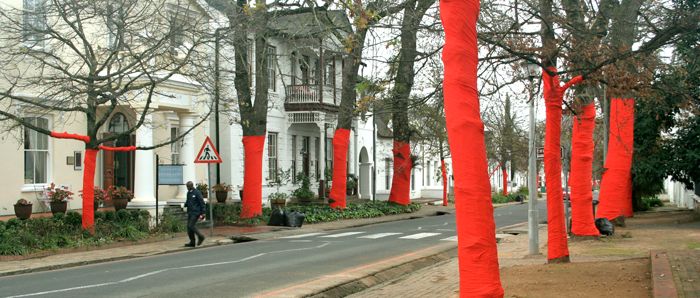
Despite their immense beauty, the Stellenbosch oaks have had a fair share of controversy. Dr Matilda burden recalls the “Battle of Andringa Street” in July 1940, where the coloured community defended themselves with oak branches from an attack by white students. A 2004 high court ruling against the Stellenbosch Municipality ensured that a woman was compensated for damages done to her BMW when a heavy branch fell and caused damage to the value of R40 000. In 2008, landscape artist Strijdom van der Merwe’s Dorp street exhibition caused mixed reactions from the Stellenbosch public. Trees lining the street were covered in 8000m of red cloth. According to Mimi Seyfert from the Stellenbosch library newspapers were swamped with letters from the public. “Some people complained that the tree squirrels may suffer as a result of the artwork”, says Seyfert.


In recent times the iconic oaks have come under threat from a white tree fungus which eats into the tree-trunk. This can be seen at one of the Church street oaks where the menacing fungus caused an entire section of the tree trunk to collapse onto the sidewalk. Johan Schuman from the irrigation department at Stellenbosch University says “we are feeding the trees organic fertilizer on a regular basis to slow the disease”.

In spite of the uncertainty facing the “Town of oaks”, the trees will always form an important part of the Stellenbosch history and will ensure that the town remains a tourism hub of the Western Cape in the near future.

Friday, January 6, 2012

Aldous Huxley

Heya,

So my uncle asks me;"what are you reading?" to which I reply "an autobiography on Aldous Huxley". With a dissapointing tone he reckons;"he can't be well known because I've never heard of him". I kept quiet, and thought to myself....

If only you knew. Aldous Huxley was the grandson of the prominent biologist Thomas Huxley, who is best known as "Darwin's bulldog" for his advocacy of the theory of evolution. Huxley jnr began his writing career in his middle twenties and soon established himself as a witty satirist.

His early days were punctuated with fascinating friendship circles and influences. These encounters formed the basis of many of his later novels much to the chagrin of the real-world characters. Huxley was an avid traveller and changed homes as often as underwear. It becomes apparent that his mobile lifestyle provided much inspiration for his writing.

So what exactly did Huxley write about? Well, I half-read his last novel titled "island" and started listening to an audiobook of "chrome yellow". His books seem to comprise much dialogue and he successfully uses the characters to breath life into his ideas. His interests are vast and include all the heavy hitters; religion, politics, gender, mysticism, science, drugs, sex. An absolute feast for my brain. Yes, I devour his ideas like a good braaivleis.

Oh yes, I also half-read "the Doors of perception" (an immensely popular 1960's rock band would later call themselves "the Doors"). Would you believe that this old geezer at the age of 61 experimented with mescalin? Mescalin is the active ingredient of peyote, a cactus plant native to Texas and Mexico. Through its psychoactive properties Huxley hoped to achieve enlightenment through artificial means....Nice try, dude! It sounds like a nice trip...Anyway, I expected more from the book.


Huxley is one of the few authors I know who uses his novels to explore the possibilities of integrating science and mysticism. I am a firm believer that similar endeavors holds much promise in the future. I certainly hope to add to this fascinating topic. I admire his willingness to test science and mysticism on himself. The most telling example was on his deathbed when he asked his wife to inject him with 100 micrograms of LSD...

Wednesday, December 28, 2011

Dances with Devils- a journalist's search for truth....the review

Heya,

Its the festive season, yay!! I’m just about halfway through the four prescribed books listed for my imminent journalism course for 2012. So I just thought i’d spew some thoughts on my latest read; “Dances with devils”, by Jacques Pauw.
Eish!! This whitie had me confused from the start, but in an entertaining way. He made me realise that progressive Afrikaners do exist. He is a vehement critic of the apartheid establishment and his journalistic “journey” testifies to this. His book comprises a collection of stories spanning his then twenty-year experience as a journalist on the frontlines.


Pauw’s countless expose’s on the apartheid security police makes for very thrilling reading. Working under Max du Preez for the Afrikaans leftist newspaper “vrye weekblad”, he exposed the brutality of the dark force. His up-close encounters with characters like “Dirk Coetzee” and Eugene de Kock (AKA prime evil) will soon bring you to the conclusion that the guy is hooked on adrenalin. These vlakplaas commanders were known to maim black activists with anything ranging from bombs and bullets to electricity and fire. Yet, it was not only so called “boere” that were heinous. Some black defectors took pride in killing their own ‘kind’.

Doubtless, Pauw’s journalistic prowess landed him a job with SABC’s Special Assignment. Here he covered the juiciest “beats”, which took him around Africa. While we were celebrating the dawn of democracy in 1994, Pauw was covering the Rwandan genocide which saw the extermination of thousands (if not hundreds of....) of Tutsis. He describes in gory detail how people were hacked with machetes and raped with gun barrels, to mention but a few atrocities.

It seems as though the armpits of Africa had too much promise for stories. Pauw soon found himself in war torn Sudan where he experienced the clashes first-hand. The Sudan chapter convinced me that it would probably be better to die in battle than starvation where I imagine the stomach eats itself. By the way, the Sudanese consider beef innards (lungs, heart etc.) more of a delicacy than the actual meat....that’s twisted!!!

If these stories don’t grab you, then I’m sure you’ll like his investigative piece centered around pastor TB Joshua....what a fake!!! Would you believe that prominent South African rugby players thought that this crook could cure their terminal illnesses? These guys literally flew to Lagos in Nigeria whereupon they were advised to discard their meds and put all faith in TB; WTF!!! Another old man was duped into thinking he’d be cured from HIV.

People.....these are just a few of the stories I feasted on. With descriptive writing and a sense of risqué, there was never a dull moment. Pauw throws his personality into this book with reckless abandon and takes us on a rollercoaster jol with African devils....A winner!!!

Thursday, November 3, 2011

If you were born in the 80's

Heya!

So, its back to blogging after countless excuses. My return to cyberspace was spurred on by my recent acceptance in the Stellenbosch journalism class for 2012. Yes, I need to do this before the world comes to an abrupt end on December 12th (I think). Jokes aside..... The journo department has forwarded a list of 16 books as recommended reading, four of which is holiday reading to be completed by Feb 2012.


So my fun starts with “Our Generation” by Zubeida Jaffer. An excellent autobiography providing insight into the 80’s and 90’s struggles against the apartheid regime. Even more telling is the fact that it is the experience of a woman, soon-to-be mother, and what seems to be a feminist questioning the patriarchal Islamic conventions. So, here we have a multifaceted story that resonates with me at many levels.

The main thread of the story is the birth of Zubeida’s daughter (Ruschka) during the heat of the uprisings in 1986. This is a year after my birth in May 1985. With delicate detail the author describes the conditions surrounding her pregnancy (especially scrutiny by the security police) and thus encourages me to question the conditions of my birth...what were the challenges?

Well, from what I know, my mother was a junior lecturer at UWC at the time. A feisty feminist educated in Sweden and reading some gender-related stuff. Probably an activist in her own right, sharing the vision of the then rector Jake Gerwel and other colleagues for a non-racial institution. But nothing hectic like being watched by the police...I think. At the time my dad was teaching maths, a long –standing passion that plays second fiddle only to politics and his revolutionary fervour. A UCT-dropout that was swept up by the writings of Marx, Lenin, and Trotsky combined with the prevailing political climate. Prior to my birth he was captured when trying to join the ANC military wing outside of South Africa. I am proud to say that he survived torture and solitary confinement. However, the scars still run deep. I suspect that he suffers post-traumatic stress and the experience has amplified manic depression, a diagnosis that I seem to have inherited (hence the name of this blog!).


Zubeida’s love interest enters the book and maintains a very mysterious element throughout the story. When I saw the name ‘johnny’ within the context of this story my gut told me I knew this guy. My dad always spoke about Johnny Issel; I even remember the tall Indian-looking man with the curly hair at our house. I never had a clue about the pivotal role he played in the struggle and what I was being exposed to. Other stalwarts that I’ve had the priviledge of meeting include Cecil Esau who organizes the annual Ashley Kriel memorial lecture (I used to attend these when the hardened core of the then UDF attended; I think now its becoming soft, commercialized, and bureaucratic barring my attendance...sad).


Zubeida’s 10 yr marriage to Johnny ends in a divorce which the writer prefers not to elaborate on. Interestingly my parents have also called it quits. Moreover, many of their friends relationships have broken down; especially friends with a certain level of activism. Is this a trend??

So I have not finished reading the book but I really like how the story is built around her daughter Ruschka. I imagine the story would end with Zubeida speaking about her hopes for especially the 1980’s generation. Us that now have to take (no, in fact pick-up) the baton and continue the race. I once heard that each generation produces its own leaders.....the 1980’s gave birth to us.

Friday, August 12, 2011

Open mic.....enter my world


Always create!

As products of divine creation
How is it that we lack inspiration?
Where the breath of God dwell
Man should cast his creative spell;
Develop new words and new ways
To lengthen your days....
Inspire the nation with artistic procreation


Father God and Mother Earth

When they met he got lost in space and time
It was a sign of the divine
The cosmos observed the sight
Of spermitic meteorite
An eclectic one struck earth
...Birth!

The heavens opened
Welcoming the Son;
Light and life giver
In the form of a man
His love flowed like a river
With godly devotion
His crimson stained the ocean

The blood sustains and keeps us buoyant
Liquid redemption for the miscreant
Inherent salinity is the pathway to divinity
We the salt of the earth
...second Birth!

Saturday, February 26, 2011

BB: "Bipolar Balance"....

Heya,

So February is drawing to a close and still no blog.....lets ‘get busy living’. That’s the catch phrase of Goldfish’s new album. From previous blogs I think we can all agree that living with bipo can be quite a challenge. I’ve come to realise that within every challenge lies an opportunity. What then is the opportunity presented by being a sufferer? I like to think of it as “BB”. No! Not Black Berry. I’m referring to ‘Bipolar Balance’.


I consulted a website (http://www.bipolarsupporter.com/bipolarsupporterblog/three-bipolar-magic-words-for-you/) that used the analogy of a table supported by four legs. These represent; physical, mental, emotional, and spiritual elements of wellbeing. It follows that if any of the legs are weakened or collapse, it compromises the stability of the table. We also know that the tabletop (i.e. us) often support many things (e.g. children, spouses, partners etc.).

This brings me to my personal situation where the December vacation period seems to systematically knock the legs from under my table. I stopped exercising and indulged uncontrollably on holiday foods, this had a physical impact. I consumed more alcohol than necessary and often changed my sleeping patterns with late nights, this impacted the mental. I also spent less time with spiritual activities like church and prayer. Can you now imagine a table providing support with three weakened legs?


The implications were far-reaching. Suffice to say, I’m slowly getting back into an exercise regimen,trying to log 7-8 hrs of sleep daily, and eating almost sufficient fruit and nuts. I’m not surprised that things are slowly falling back into place.....and I’m seeing this as an opportunity to attain BB!

Tuesday, January 4, 2011

Polygamy rediscovered!

Heya,

I am of the opinion that when a bipolar sufferer experiences acute psychosis; they lose all their sense of pride and ego. We are often very in touch with our deepest feelings that have been buried beneath many years of schooling and indoctrination. We feel free and in touch with the divine...the outside world calls us crazy when we are inspired to lose our clothes in public. We are then met with brute force,...padded rooms and tranquilizers. It was against this backdrop that I rediscovered myself.

I recalled all the bible stories that my dad re-enacted for me as a kid...David and Goliath, Daniel in the lion’s, and Samson. All the ‘rockstars’ of the Bible. This got me through the endless days at the mental hospital. I discovered that I could make words rhyme, although I was writing a load of crap while ill. Apparently I love nature and the environment which inspired me to water the courtyard plants and pick up all the cigarette butts strewn around by the drug-addicts, and depression patients. I also had girls on my mind, two of them. One was in the front of my mind; my girlfriend at the time, and one was at the back of my mind; a friend and fellow student.....in my reality I was a polygamist.


In respect to these discoveries I can tick all the boxes comfortably except one; I appreciate the Bible, I enjoy writing poetry, I make a contribution to natural history through my studies....but am I a natural polygamist?? Let’s see...Well, I definitely like girls and am attracted to certain physical features, but hygiene, intelligence, wit, spirituality, compassion, and friendliness rank highly. I am surrounded by many such; unfortunately a large majority of the male population are in jail, jerks, or jocks. It does not take complex math to calculate that there is an excess of decent, yearning women who are now turning towards each other for comfort.

According to societal norms it is best to choose one mate for life. Is this the best option given the current state of society? Due to my nature and the requirements of nature I am forced into a form of polygamy. Maybe not at the physical level, but definitely spiritually and intellectually....

Spiritual Polygamy!

A plural relationship
Not based on ownership
He comes, He goes
Taking care of their woe’s
Frees them from their needs;
Spiritual and intellectual
No need for nothing sexual

A new Solomon with many wives
The new man will change countless lives
A different kind of wealth
Leading to societal health
Intercourse will include discourse;
Procreating new ideas and ways
To lengthen our days....

Friday, December 17, 2010

Tis' the season to be suffering....

Heya,

So the festive season is usually associated with happy days, smiles, and pleasant socializing. For some bipolar sufferers this period, marked by the joys of Christmas, is pure hell. Having to fake smiles and betray your true feelings can be testing. Furthermore, many sufferers often have alternate worldviews that do not place much emphasis on Christmas....making things worse.


Personally, the festive season has always been a happy time for me....partly because it usually coincided with the manic phase of my bipolar mood cycling. This is best explained by the longer (southern hemisphere) summer days exposing me to more light, which is important for uplifted mood. My dad (also a sufferer), on the other hand, in the past, has not handled the festivities that well. In my opinion this could be for a couple of reasons; post-traumatic stress, the prevailing situation, he does not subscribe to any religious orthodoxy, or that he has a different diagnosis (i.e. type of disorder e.g. bipolar 1 or 2). In any case, he’s doing better now.

So, seeing as Christmas is a time for giving. I’ve decided to give myself pain...because “pain is love”, right? I got myself a tattoo, two actually. It was quite a deep experience, excuse the pun. Maybe I should use the word profound....It inspired me to get poetic. So if I may....

Etched on my skin

Pain is the vehicle that
Drives home the message...
Buzzing like a humble bee
The needle whispers...Carpe diem,
Expressing seizure of the day, pray,
And allow yourself to go astray

Pain is the vehicle to
The destination of truth...
Stabbing the soul
The needle shouts: Memento mori!
He will come like a thief in the night;
No time to say sorry

**Carpe diem:(KAHR-peh DEE-em)
Latin for "seize the day," a common motif in lyric verse throughout the history of poetry, with the emphasis on making the most of current pleasures because life is short and time is flying


**Memento mori:
Related but distinct is the expression memento mori ("remember that you are mortal"); indeed, memento mori is often used with some of the sense of carpe diem. However, two major elements of memento mori are humility and repentance, neither of which figures prominently in the concept of carpe diem. So the two phrases could also represent opposing worldviews: with 'carpe diem' representing carefree, overflowing life and 'memento mori' a humble, meek existence

Friday, November 19, 2010

Bipolar thoughts ‘On Suicide’...

Heya,

This is a most difficult blog post because it deals with death and the deceased. However, I believe that I have a duty towards truth....Suicide is a sad reality in modern day times with children as young as 10 retiring from life. In 2008, the Independent reported that 22 people committed suicide daily in South Africa. Also, for every one suicide there are 10 attempted suicides. These are shocking statistics.


My first confrontation with suicide came in 2007 when a classmate decided to take his own life. We where not very close but for some strange reason this event rocked me at the core. I got home that day and just burst into tears. Now, at such times I am usually restricted in trying to express myself in the English language. So I found much consolation in writing the following poem....

Dear Dale...
Everyone’s asking you “why?”
Even I look to sky and ask:
WHY??
Oh why?

Dear Dale...

Is it us: your friends, your family,
Your dog, academia, SOCIETY or
Curiosity of the afterlife.
I sincerely hope that curiosity killed
The cat!!

Dear Dale...

Everyone’s asking WHY??
Oh why? To me it’s like asking why
A dog is a man’s best friend.
Both you and I know that nobody
knows, but “why” brings us very close to truth.

Dear Dale...

You’ve taught me all
I need to know and that is:
“to be true to myself at any cost”

Dearest Dale...

Why did the
DOG bite you??

The period after this event was turbulent times for me with family troubles and study pressures. This lead to my own personal dark period of depression. The world was all grey and I could describe myself as infinitely hopeless- I was considering the unspoken. It was during this time that I stumbled upon the philosophy of David Hume (1711-1776). In his book, On Suicide. I believe that no man ever threw away life while it was worth keeping, he argues that the act of suicide in no way interferes with GOD’s divine providence. That we too are bound by the general laws of nature and motion; and that our decisions flow from the inception of the earth. Furthermore he poses the question of why we should be confined to miserable lives on earth; i.e. should we please society at our own expense?


I was looking for someone to validate my decision to take my own life....The garage was to be my stage. I found unused electrical cable and strangely in setting myself up I knew exactly what to do; it was like I was in autopilot. For some strange reason I had to consult one last book, the Bible, to see if it said anything or mentioned an example of suicide. The only example of suicide in the bible was of Judas. This was not someone I could identify with in any way....and that was my turning point. I had myself admitted to a mental clinic and was diagnosed as manic-depressive, suffering from Bipolar type 1.

Suicide is a sad reality for people living with bipolar. It is estimated that 20% of people with bipolar will kill themselves. “That's one out of every five! And as many as 50% - half! - of all people with this disorder may attempt suicide at least once in their lives” (http://bipolar.about.com/od/suicide/Suicide.htm). I can only bear testimony to this statistic, but also show that I have survived....for now. I leave you with the following quote by the late Kurt Cobain, a rock star who is thought to have suffered from bipolar and committed suicide in 1994....”It’s better to burn out than fade away”.

Sunday, October 17, 2010

Pesco-vegetarianism...

Exactly one month ago I cut all meat products save fish, eggs, and milk out of my diet. My reason for taking such an extreme step often baffles people when I try to explain it. On second thought it may even be a challenge to some....


I believe my love for meat is unhealthy for me. I cannot control my appetite when the opportunity or thought of something meaty presents itself. This is made far worse by the fact that I am a bipolar sufferer where my medications cause a drastic increase in appetite and subsequent weight gain. From a spiritual perspective (*I trust that my secular audience will excuse me for a moment) I would describe myself as a meat glutton. Now gluttony is a sin; and we know that the wager of sin is death; spiritual and other. I think Jesus once said that if your eye makes you sin, take it out, or your hand, chop it off. So in trying to nourish my spiritual man, I’ll need to avoid unhealthy food.


Now this is obviously a very personal decision based on physical and spiritual reasons. My friends and family argue that I am an extremist and not addressing the problem which is moderation. The best answer I can provide at this moment is that this is my personality and also a manifestation of my condition. At its core, bipolar is a condition of extremes; sadly suicidal or manically magnificent. Furthermore I believe that there is a wrong way and a right way.

Physically (and spiritually), I haven’t felt this good in a long time. I don’t miss that heavy feeling after over-eating on a meaty dish. I still crave meat sometimes but I remind myself that it clouds my mind and spirit. Also, I’m happy to announce that I’ve lost 2-3 kg’s.

Saturday, October 2, 2010

MSc 2010...Velvet worm fieldwork

Heya,

So fieldwork/data collection for my MSc is going fullsteam ahead. I hav'nt slept in the same bed for more than two successive days in a while now. If you don't know already I'm collecting velvet worms across the Western Cape. My fieldwork assistant (i.e. the very talented and capable Anzio Abels) and I are currently collecting in the Overberg region. This area is amazingly beautiful. For example, Harold Porter Botanical Gardens in Betty's bay has some of the most beautiful and exotic waterfalls to be found in the Western Cape.


Waterfall in Leopard's Kloof at Harold Porter Botanical Garden (Betty's Bay)

Staying at various backpacker lodges makes the experience loads of fun. The hosts are often informal and open-minded. We also get to meet interesting people; this one foreign couple cycled from Kenya and were on there way back via Mozambique...cool hey!?

So what does fieldwork entail? Basically we look for habitat that seem suitable for velvet worms (e.g. moist, humid, sheltered, forest patches). Here we scratch around in leaf litter and rotting logs/branches until we strike gold (i.e. amazingly curious velvet worms!!). Sometimes this requires long hikes into mountain ravines but finding these creatures are worth the effort. The last part of the exercise is taking the GPS coordinates, making some notes, and then preserving them in ethanol for DNA sequencing at a later stage.


Velvet worm in rotten branch (Heldeberg reserve)


Anzio doing his thang!!

Recently I've had the priviledge of explaining to people what exactly I'm doing my MSc thesis on. I am quite taken by the level of interest shown. So I've decided to use this blog to post some pictures as well as my research proposal presentation. Enjoy...